Topic Overview
Measures of Central Tendency
1. Definition of Central Tendency
Core Definition
- A measure of central tendency is a single value that represents the center of a dataset
- It gives an idea about the typical or average value
Key Concepts
- Summarization of data
- Converts large data into a single representative value
- Representative value
- Reflects the overall pattern of the dataset
Easy Example
- Data: 2, 4, 6, 8, 10
- Central value → around 6
→ This represents the dataset
2. Types of Central Tendency ⭐
Mean (Arithmetic Mean)
Definition
- The mean is the average of all observations
- It is calculated by dividing the sum of values by number of observations
Formula ⭐
xˉ=∑xn\bar{x} = \frac{\sum x}{n}xˉ=n∑x
For Grouped Data ⭐
xˉ=∑fx∑f\bar{x} = \frac{\sum f x}{\sum f}xˉ=∑f∑fx
Easy Explanation
- Add all values → divide by total number
- For grouped data → multiply frequency with value
Example
- Data: 2, 4, 6, 8
- Mean = (2+4+6+8) / 4 = 5
Important Exam Points ⭐
- Most commonly used measure
- Affected by extreme values (outliers)
Median
Definition
- Median is the middle value after arranging data in ascending or descending order
Method of Calculation ⭐
Odd Number of Observations
- Median = value at position
(n + 1) / 2
Even Number of Observations
- Median = average of two middle values
n/2 and (n/2 + 1)
Worked Example ⭐
Odd Case
- Data: 1, 3, 5, 7, 9
- Median position = (5+1)/2 = 3rd value
- Median = 5
Even Case
- Data: 2, 4, 6, 8
- Middle values = 4 and 6
- Median = (4+6)/2 = 5
Easy Understanding
- Median divides data into two equal halves
- Not affected by extreme values
Important Exam Points ⭐
- Median = middle value
- Requires arrangement of data
- Preferred when data has outliers
Short Note (Revision)
- Mean → average
- Median → middle value
- Mean affected by outliers
- Median not affected
Mode
Definition
- Mode is the most frequently occurring value in a dataset
- It represents the value that appears maximum number of times
Easy Explanation
- Data: 2, 4, 4, 6, 8
- Mode = 4 (appears most frequently)
Characteristics ⭐
- May not be unique
- Dataset can have:
- One mode → Unimodal
- Two modes → Bimodal
- More → Multimodal
- Useful in categorical data
- Best for qualitative data
- Example:
- Most common blood group
- Most common disease
- Not affected by extreme values
- Outliers do not influence mode
Important Exam Points ⭐
- Mode = most frequent value
- Useful for categorical data
- May have multiple modes
Short Note (Revision)
- Most frequent value
- Can be multiple
- Useful in qualitative data
Characteristics of a Good Average ⭐
Essential Features
- Simple to understand
- Should be easy for anyone to interpret
- Easy to calculate
- Calculation should not be complicated
- Based on all observations
- Should consider entire dataset
- Not affected by extreme values
- Should be stable even if outliers are present
- Capable of further analysis
- Should be useful for:
- Statistical calculations
- Comparisons
- Research analysis
Easy Understanding
- A good average should be:
- Simple + reliable + representative
Important Exam Point ⭐
- Ideal average = simple, stable, representative, and usable for analysis
Short Note (Revision)
- Simple
- Easy to calculate
- Uses all data
- Not affected by extremes
- Useful for analysis
Mean ⭐
Properties
- Uses all data values
- Every observation contributes to the mean
- Affected by extreme values (outliers)
- Very high or low values can distort the mean
Advantages
- Mathematical usefulness
- Can be used for:
- Further calculations (SD, variance, regression)
- Stability
- Less fluctuation in repeated samples
Disadvantages
- Influenced by outliers
- Not suitable for skewed data
Quick Example
- Data: 2, 4, 6, 8, 100
- Mean = 24 → not representative due to outlier
Median ⭐
Properties
- Not affected by extreme values
- Outliers do not change median
- Divides data into two equal halves
- 50% values below, 50% above
Advantages
- Suitable for skewed data
- Best when extreme values are present
Disadvantages
- Does not use all observations
- Only depends on middle value
Quick Example
- Data: 2, 4, 6, 8, 100
- Median = 6 → more representative
Mode
Properties
- Most frequent value
- Highest occurrence in dataset
Advantages
- Useful for nominal/categorical data
- Example:
- Most common blood group
- Most common disease
Disadvantages
- May be multiple or no mode
- Data may be:
- Bimodal
- Multimodal
- No mode
Quick Example
- Data: 2, 4, 4, 6, 8
- Mode = 4
High-Yield Comparison (Exam Trick) ⭐
Mean
- Uses all data
- Affected by outliers
- Best for symmetrical data
Median
- Middle value
- Not affected by outliers
- Best for skewed data
Mode
- Most frequent value
- Used for categorical data
- May not be unique
Short Note (Revision)
- Mean → average (affected by extremes)
- Median → middle (stable)
- Mode → most frequent
| Feature |
Mean |
Median |
Mode |
| Definition |
Sum of all values ÷ number of observations |
Middle value after arrangement |
Most frequent value |
| Data Used |
Uses all observations |
Does not use all values fully |
Based on frequency |
| Effect of Outliers |
Affected |
Not affected |
Not affected |
| Best Use |
Symmetrical data, further calculations |
Skewed data |
Categorical/qualitative data |
| Example |
Average marks |
Income distribution |
Most common blood group |
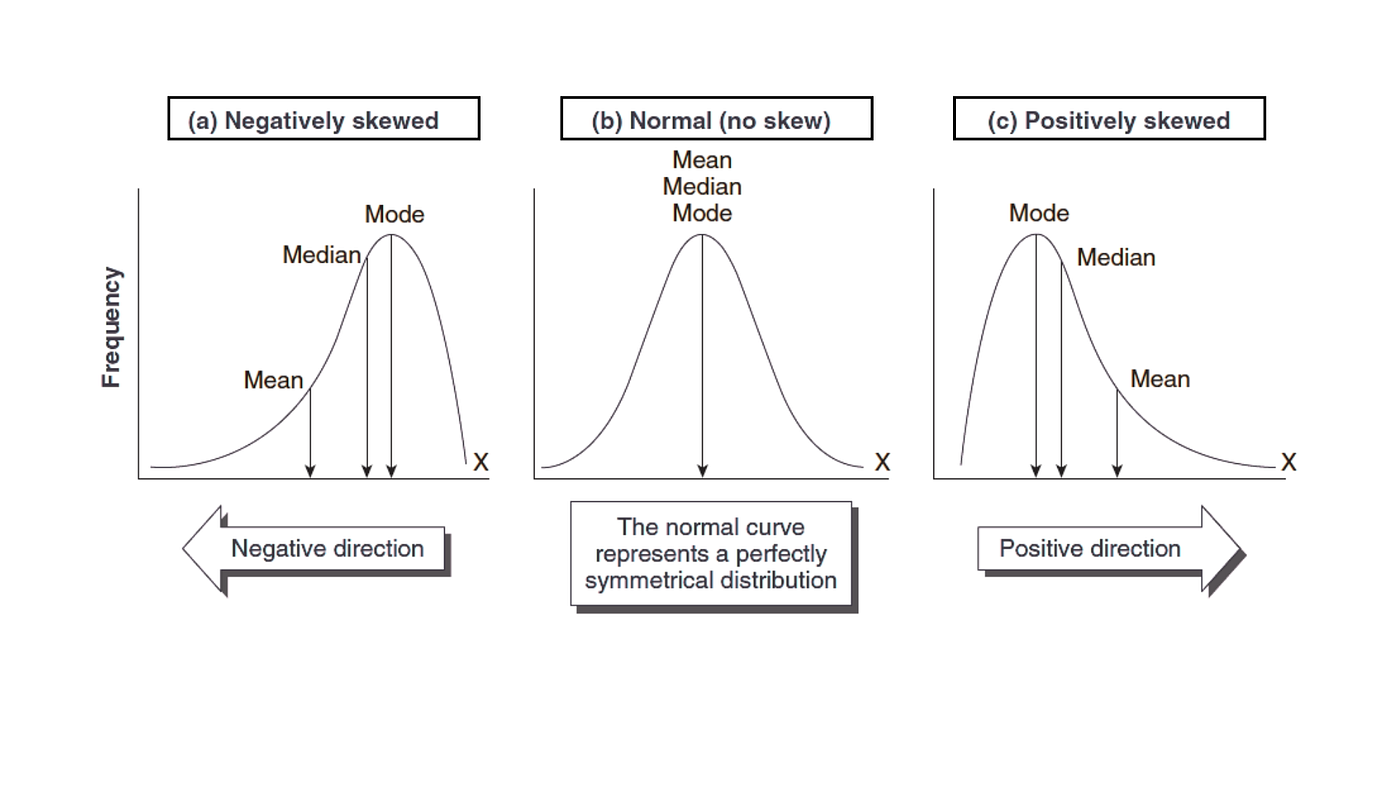
Skewness ⭐
Definition
- Skewness is the measure of asymmetry of a distribution
- It shows whether data is symmetrically distributed or shifted to one side
Easy Explanation
- If data is evenly spread → Symmetrical
- If tail extends to right/left → Skewed distribution
Types of Skewness ⭐
1. Symmetrical Distribution
- Data is evenly distributed on both sides
- Mean = Median = Mode
2. Positive Skew (Right Skew)
- Tail extends towards right side
- Few high extreme values present
- Relationship:
3. Negative Skew (Left Skew)
- Tail extends towards left side
- Few low extreme values present
- Relationship:
Diagrams (VERY IMPORTANT) ⭐


4
Interpretation ⭐
Direction of Skewness
- Right tail → Positive skew
- Left tail → Negative skew
Clinical / Epidemiological Examples
- Positive Skew
- Income distribution (few very high incomes)
- Hospital stay duration (few long stays)
- Negative Skew
- Age at death in developed countries (most live longer)
- Symmetrical
- Normal distribution (e.g., height in population)
Important Exam Points ⭐
- Skewness = asymmetry of distribution
- Formulas to remember:
- Positive skew → Mean > Median > Mode
- Negative skew → Mean < Median < Mode
Short Note (Revision)
- Symmetrical → Mean = Median = Mode
- Positive skew → Right tail
- Negative skew → Left tail
Measures of Dispersion
Definition of Dispersion
Core Definition
- Dispersion is the measure of spread or variability of data
- It shows how far the values are scattered from the central value
Easy Explanation
-
Same mean, different spread:
Data 1: 5, 5, 5, 5 → No dispersion
Data 2: 1, 5, 9, 5 → High dispersion
Importance ⭐
- Shows reliability
- Less dispersion → data is more reliable
- Indicates consistency
- Small spread → consistent data
- Large spread → variable data
Types of Dispersion ⭐
1. Range
Definition
- Range is the difference between highest and lowest value
Formula ⭐
Range=Max−Min\text{Range} = \text{Max} - \text{Min}Range=Max−Min
Easy Example
- Data: 2, 4, 6, 8
- Range = 8 – 2 = 6
Advantages
- Simple and easy to calculate
- Quick idea of spread
Limitations
- Uses only two values (max & min)
- Not reliable
- Affected by outliers
2. Quartile Deviation (Semi-IQR)
Definition
- Based on quartiles (Q1 and Q3)
- Measures spread of middle 50% data
Formula ⭐
QD=Q3−Q12QD = \frac{Q_3 - Q_1}{2}QD=2Q3−Q1
Easy Explanation
- Q1 → 25th percentile
- Q3 → 75th percentile
- Focuses on central data, ignores extremes
Advantages
- Not affected by extreme values
- Better than range
Limitations
- Does not use all data
- Limited mathematical use
3. Mean Deviation
Definition
- Mean deviation is the average of absolute deviations from mean or median
Easy Explanation
- Calculate how far each value is from mean
- Take average of those distances
Example (Concept)
- Data: 2, 4, 6
- Mean = 4
- Deviations: 2, 0, 2
- Mean deviation = (2+0+2)/3 = 1.33
Advantages
- Uses all observations
- Better than range
Limitations
- Absolute values → difficult for further calculations
- Less commonly used
Important Exam Points ⭐
- Range → simplest
- QD → middle spread
- Mean deviation → average distance
Short Note (Revision)
- Dispersion = spread of data
- Range → max – min
- QD → (Q3 – Q1)/2
- Mean deviation → average deviation
Standard Deviation (SD) ⭐ MOST IMPORTANT
Definition
- Standard deviation (SD) is a measure of variability of data around the mean
- It tells how much the values deviate (spread) from the average
Easy Explanation
- Small spread → values close to mean → low SD
- Large spread → values far from mean → high SD
Formula ⭐
For Individual Data
SD=∑(x−xˉ)2nSD = \sqrt{\frac{\sum (x - \bar{x})^2}{n}}SD=n∑(x−xˉ)2
For Grouped Data
SD=∑f(x−xˉ)2∑fSD = \sqrt{\frac{\sum f (x - \bar{x})^2}{\sum f}}SD=∑f∑f(x−xˉ)2
Easy Steps (Exam Trick)
- Find mean (x̄)
- Calculate (x − x̄)
- Square → (x − x̄)²
- Take average
- Take square root
Interpretation ⭐
- Small SD
- Data is closely clustered around mean
- More consistent & reliable
- Large SD
- Data is widely spread
- Less consistency
Example
- Data 1: 5, 5, 5, 5 → SD = 0 (no variation)
- Data 2: 1, 5, 9, 5 → SD is high
Important Exam Points ⭐
- Most important measure of dispersion
- Uses all data values
- Essential for:
- Normal distribution
- Z-score
- Statistical tests
Short Note (Revision)
- SD = spread around mean
- Small SD → consistent
- Large SD → variable
Variance
Definition
- Variance is the square of standard deviation
- It measures spread in squared units
Formula ⭐
Variance=SD2\text{Variance} = SD^2Variance=SD2
Easy Explanation
- Variance = average of squared deviations from mean
- SD = √Variance
Important Exam Points ⭐
- Variance = SD²
- Units are squared
- SD is preferred for interpretation
Short Note (Revision)
- Variance = square of SD
- SD more useful clinically
Properties of Standard Deviation ⭐
Key Properties
- Always positive
- SD is never negative
- Because deviations are squared before calculation
- Minimum value = 0 (when all observations are same)
- Based on all observations
- Every data value contributes to SD
- Makes it a reliable measure of dispersion
- Affected by extreme values (outliers)
- Very high or low values can increase SD significantly
- Hence, SD is sensitive to skewed data
- Algebraically tractable
- Can be used in mathematical/statistical calculations
- Important for:
- Variance
- Z-score
- Normal distribution
- Regression & correlation
Easy Understanding
- SD = powerful + precise + mathematically useful
- But → sensitive to outliers
Important Exam Point ⭐
- SD is:
- Always positive
- Uses all data
- Affected by outliers
- Mathematically useful
Short Note (Revision)
- Always positive
- Uses all observations
- Affected by extremes
- Useful in calculations
Coefficient of Variation (CV) ⭐
Definition
- Coefficient of Variation (CV) is a relative measure of variability
- It expresses standard deviation as a percentage of mean
- Helps compare variability between different datasets
Formula ⭐
CV=SDxˉ×100CV = \frac{SD}{\bar{x}} \times 100CV=xˉSD×100
Easy Explanation
- CV tells how large the variation is compared to the mean
- Lower CV → more consistency
- Higher CV → more variability
Uses ⭐
- Compare consistency between datasets
- Used when:
- Means are different
- Units are different
Example (Comparison) ⭐
Dataset A
CV = (10 / 100) × 100 = 10%
Dataset B
CV = (10 / 50) × 100 = 20%
Interpretation ⭐
- Dataset A → CV = 10% → More consistent
- Dataset B → CV = 20% → Less consistent (more variation)
Exam Trick ⭐
- Lower CV → Better consistency
- Higher CV → More variability
Important Exam Points ⭐
- CV = relative measure
- Used for comparison
- Expressed in percentage
Short Note (Revision)
- CV = (SD/Mean) × 100
- Lower CV → more stable
- Used to compare datasets
Normal Distribution & SD ⭐
Definition
- A normal distribution is a symmetrical, bell-shaped distribution
- Data is distributed evenly around the mean
Properties ⭐
- Mean = Median = Mode
- All central tendencies coincide at the center
- Symmetrical distribution
- Total area = 100%
- Entire curve represents 100% of data
Easy Explanation
- Most values lie near the mean
- Few values lie at extremes (tails)
Standard Deviation Distribution ⭐
- 68% of data → within ±1 SD
- 95% of data → within ±2 SD
- 99.7% of data → within ±3 SD
👉 This is called the Empirical Rule (68–95–99.7 rule)
Diagram (Bell-shaped Curve with SD Markings) ⭐


4
Interpretation ⭐
- Narrow curve → Small SD → Less variability
- Wide curve → Large SD → More variability
- Majority of values cluster around the mean
Clinical / Epidemiological Relevance
- Biological variables:
- Height
- Weight
- Blood pressure
- Used in:
- Reference ranges
- Z-score calculations
- Statistical tests
Important Exam Points ⭐
- Bell-shaped curve
- Mean = Median = Mode
- 68–95–99.7 rule (VERY FREQUENT MCQ)
Short Note (Revision)
- Normal distribution → symmetrical
- Mean = Median = Mode
- 68% → ±1 SD
- 95% → ±2 SD
- 99.7% → ±3 SD
Uses of Dispersion
Core Uses ⭐
- Measure reliability of data
- Less dispersion → more reliable data
- More dispersion → less reliable
- Compare datasets
- Helps compare variability between two or more groups
- Example: Using SD or CV to compare consistency
- Understand variability
- Shows how much data values differ from the average
- Helps identify spread and distribution pattern
Easy Example
- Dataset A → SD = 5 (less spread)
- Dataset B → SD = 20 (more spread)
→ Dataset A is more consistent
Public Health Applications ⭐
- Epidemiological studies
- Assess variation in:
- Disease occurrence
- Risk factors
- Research interpretation
- Helps interpret:
- Study results
- Clinical trial outcomes
Clinical Example
- Blood pressure readings:
- Low SD → consistent readings
- High SD → fluctuating readings
Important Exam Point ⭐
- Dispersion helps in:
- Reliability
- Comparison
- Understanding variability
Short Note (Revision)
- Measures spread
- Helps compare datasets
- Indicates consistency
- Useful in epidemiology & research
Ready to study offline?
Get the full PDF version of this chapter.
 Continue with Google