Topic Overview
GENERAL EPIDEMIOLOGY OF COMMUNICABLE DISEASES
Definition of Communicable Disease ⭐
Core Definition
- Disease caused by specific infectious agents
- Capable of transmission from one host to another
Key Concepts
- Transmission pathways
- Person → Person
- Animal → Human (Zoonosis)
- Reservoir → Host
- Important exam point
- Not all infectious diseases are communicable
- Example → Tetanus (non-communicable infectious disease)
Components of Infectious Disease Cycle ⭐
Epidemiological Triad (VERY IMPORTANT)
- Basic model explaining disease causation
Components
- Agent
- Microorganism causing disease
- Bacteria, viruses, parasites, fungi
- Host
- Susceptible individual
- Influenced by immunity, age, genetics
- Environment
- External factors affecting transmission
- Climate, sanitation, vectors, crowding
Epidemiological Triad Diagram ⭐

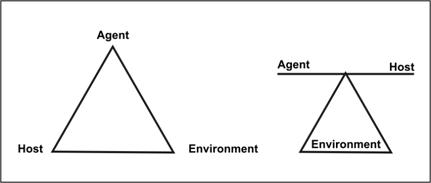

4
Interaction Concept ⭐
- Disease occurs when:
- Agent + susceptible host + favorable environment interact
- Equilibrium
- Balanced interaction → No disease
- Imbalance
- Leads to disease occurrence
👉 Exam Insight
- Control strategies target:
- Agent → drugs, vaccines
- Host → immunity, nutrition
- Environment → sanitation, vector control
Clinical Application 🚀
- COVID-19
- Agent → SARS-CoV-2
- Host → Humans
- Environment → Crowding, travel
- Malaria
- Agent → Plasmodium
- Host → Human
- Environment → Mosquito breeding
AGENT FACTORS ⭐ VERY IMPORTANT
Definition
- Characteristics of the causative organism that determine disease occurrence and severity
Properties of Agent
- Infectivity
- Ability of organism to enter, survive, and multiply in host
- Example → Measles (high infectivity)
- Pathogenicity
- Ability to produce clinical disease
- Example → Poliovirus (many infections, few clinical cases → low pathogenicity)
- Virulence
- Degree of severity of disease
- Example → Rabies (high virulence)
- Toxigenicity
- Ability to produce toxins
- Example → Corynebacterium diphtheriae
- Antigenicity
- Ability to induce immune response
- Basis of vaccine development
Comparison (VERY IMPORTANT MCQ) ⭐
Infectivity vs Pathogenicity vs Virulence
- Infectivity
- Entry & multiplication in host
- Deals with spread of infection
- Pathogenicity
- Ability to cause disease
- Deals with clinical illness occurrence
- Virulence
- Severity of disease
- Deals with fatality/complications
👉 Quick Exam Trick
- Infectivity → Entry
- Pathogenicity → Disease
- Virulence → Severity
HOST FACTORS
Definition
- Factors related to susceptibility of host to infection
Components
- Age
- Extremes of age (infants, elderly) → ↑ susceptibility
- Sex
- Some diseases show sex predilection
- Example → Autoimmune diseases more in females
- Immunity
- Most important factor
- Includes:
- Innate immunity
- Acquired immunity
- Nutrition
- Malnutrition → ↓ immunity → ↑ infections
- Behavior (Lifestyle & Habits)
- Personal hygiene
- Sexual behavior
- Smoking, alcohol
- Occupational exposure
Clinical Insight 🚀
- TB more common in:
- Malnourished + immunocompromised → Host factor dominance
- COVID severity:
- Elderly + comorbid → Host + agent interaction
ENVIRONMENTAL FACTORS
Definition
- External factors that influence occurrence and transmission of disease
Types
Physical Environment
- Climate → temperature, humidity affect disease spread
- Water → contamination leads to water-borne diseases
- Air → airborne infections (TB, measles)
Biological Environment
- Presence of vectors → mosquitoes, flies
- Other microorganisms interacting with host
Social Environment
- Crowding → facilitates transmission (TB, COVID)
- Sanitation → poor hygiene → diarrheal diseases
- Socioeconomic status
- Poverty → malnutrition, poor access to healthcare
Clinical Insight 🚀
- Malaria → strongly influenced by biological environment (vector)
- Cholera → linked to water contamination (physical environment)
- TB → associated with crowding (social environment)
RESERVOIR OF INFECTION ⭐
Definition
- Natural habitat where the infectious agent lives, grows, and multiplies
Types
Human Reservoir
- Case
- Person with clinical disease
- Carrier
- Person harboring organism without symptoms
Animal Reservoir
- Source of zoonotic diseases
- Examples:
- Rabies → dog
- Plague → rodents
Environmental Reservoir
- Organisms survive in non-living environment
- Examples:
- Soil → tetanus
- Water → cholera
Types of Reservoir (VERY IMPORTANT) ⭐
- Human Reservoir
- Case → Symptomatic individual
- Carrier → Asymptomatic but infectious
- Animal Reservoir
- Zoonotic transmission
- Examples → Rabies, plague
- Environmental Reservoir
- Non-living sources
- Examples → Soil (tetanus), water (cholera)
👉 Exam Trick
- Reservoir = “Where organism normally lives”
- Source = “From where infection spreads”
CARRIER ⭐
Definition
- Person harboring the infectious agent without showing symptoms
- Acts as a hidden source of infection
Types of Carrier
- Healthy Carrier
- Never develops disease
- Example → Typhoid carrier
- Incubatory Carrier
- Transmits infection during incubation period
- Example → Measles
- Convalescent Carrier
- Continues to transmit after recovery
- Example → Cholera
Types of Carrier (VERY IMPORTANT) ⭐
- Healthy Carrier
- No symptoms at any stage
- Important in disease persistence
- Incubatory Carrier
- Infectious before symptoms appear
- Important in early spread
- Convalescent Carrier
- Infectious after clinical recovery
- Important in late spread
👉 Exam Trick
- Incubatory → Before
- Convalescent → After
- Healthy → Always asymptomatic
SOURCE OF INFECTION
Definition
- Person, animal, or object from which infection is actually transmitted to host
Key Concept
- Source may or may not be the same as reservoir
Reservoir vs Source of Infection ⭐
- Reservoir
- Natural habitat of organism
- Where organism lives and multiplies
- Source of Infection
- Immediate origin from which infection spreads
- Where host actually acquires infection
Important Differences (VERY IMPORTANT) ⭐
- Reservoir
- Long-term habitat
- Example → Human in typhoid
- Source
- Immediate transmission point
- Example → Contaminated food/water
👉 Exam Trick
- Reservoir → “Lives there”
- Source → “Comes from there”
Clinical Insight 🚀
- Typhoid:
- Reservoir → Human
- Source → Contaminated water/food
- Tetanus:
- Reservoir → Soil
- Source → Wound contamination
MODES OF TRANSMISSION ⭐ VERY HIGH-YIELD
Definition
- Mechanism by which infectious agent spreads from source to host
A. Direct Transmission
Types
- Direct Contact
- Physical contact between infected and susceptible person
- Example → STDs, skin infections
- Droplet Infection
- Large respiratory droplets (>5 µm)
- Spread within 1 meter
- Example → Influenza, COVID-19
- Vertical Transmission
- Mother → child
- During pregnancy, delivery, or breastfeeding
- Example → HIV, Hepatitis B
B. Indirect Transmission
Types
- Airborne Transmission
- Droplet nuclei (<5 µm), remain suspended
- Travel long distances
- Example → TB, measles
- Vehicle-borne Transmission
- Through contaminated food, water, blood
- Example → Cholera, Hepatitis A
- Vector-borne Transmission
- Through insects
- Example → Malaria (mosquito), plague (flea)
- Fomite Transmission
- Through inanimate objects
- Example → Towels, utensils
Flowchart: Modes of Transmission ⭐
- Transmission
- Direct
- Direct contact
- Droplet
- Vertical
- Indirect
- Airborne
- Vehicle-borne
- Vector-borne
- Fomite
Direct vs Indirect Transmission (VERY IMPORTANT) ⭐
- Direct Transmission
- No intermediate object
- Immediate transfer
- Examples → Contact, droplet, vertical
- Indirect Transmission
- Requires intermediate medium
- Delayed spread possible
- Examples → Airborne, vector, vehicle
👉 Exam Trick
- Direct = No mediator
- Indirect = Mediator present
Clinical Insight 🚀
- COVID-19 → Droplet + airborne
- Malaria → Vector-borne
- Cholera → Water-borne
CHAIN OF INFECTION ⭐
Definition
- Sequence of events required for disease transmission
Components
- Agent
- Reservoir
- Portal of Exit
- Route by which organism leaves host
- Example → Respiratory secretions
- Mode of Transmission
- Portal of Entry
- Route by which organism enters new host
- Example → Respiratory tract
- Susceptible Host
Chain of Infection Diagram ⭐


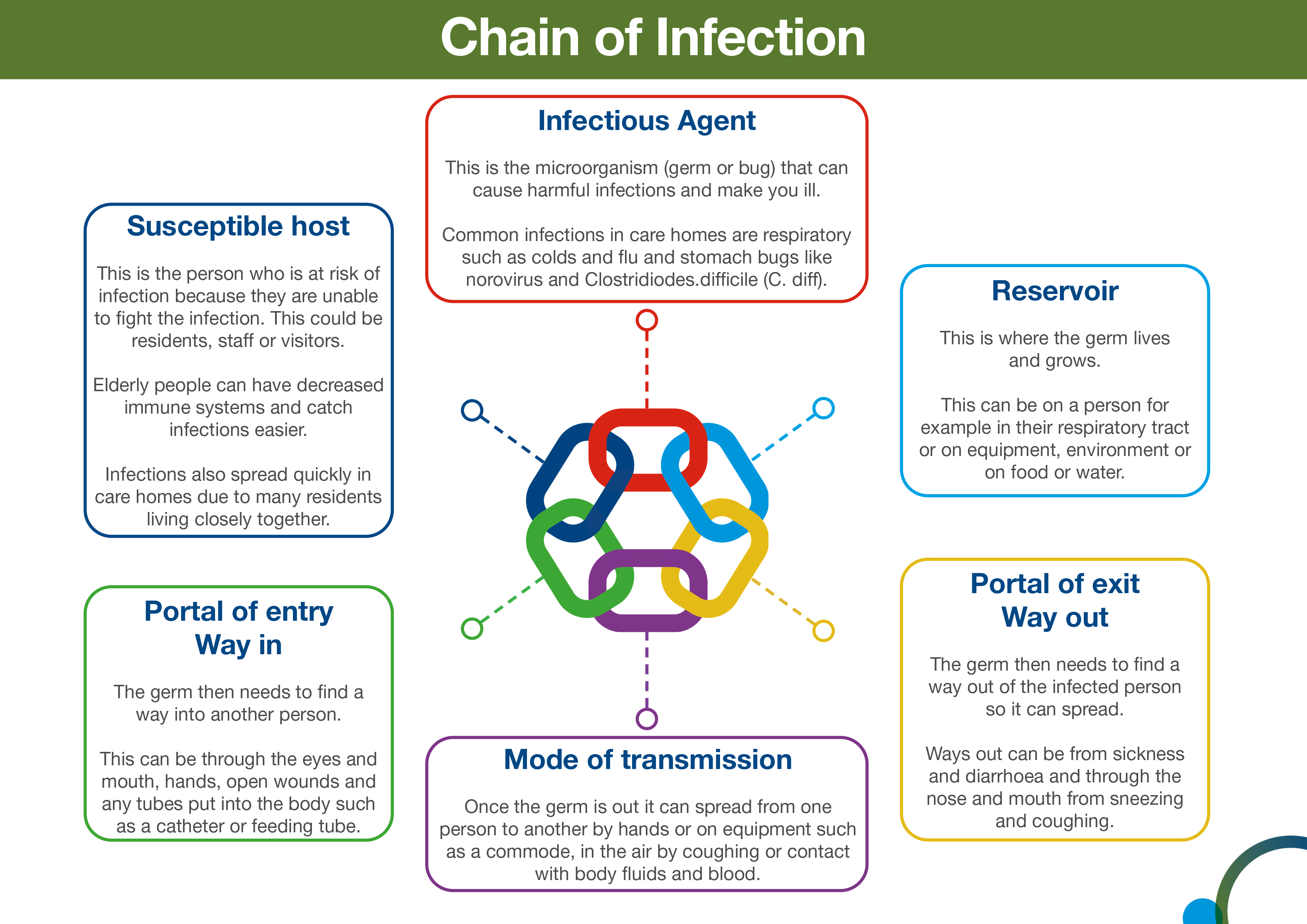
4
Key Concept ⭐
- Infection occurs only when all links are intact
👉 Prevention Principle
- Breaking any one link → Stops transmission
Clinical Insight 🚀
- Hand hygiene → breaks mode of transmission
- Vaccination → reduces susceptible host
- Isolation → controls reservoir/source
✅ Ultra High-Yield Summary
- Direct vs indirect transmission
- Droplet vs airborne difference
- Chain of infection components
- Breaking chain = disease control
INCUBATION PERIOD ⭐
Definition
- Time interval between exposure to infectious agent and appearance of first symptoms
Key Features
- Silent phase
- No clinical symptoms present
- Organism multiplies in host
- Reaches threshold to produce disease
Importance ⭐
- Diagnosis
- Helps in identifying probable exposure time
- Quarantine
- Duration based on maximum incubation period
Examples (High-yield)
- Measles → 10–14 days
- COVID-19 → 2–14 days
- Cholera → Few hours to 5 days
Exam Insight ⭐
- Short incubation period
- Rapid onset
- Example → Food poisoning
- Long incubation period
- Delayed onset
- Example → Rabies
PERIOD OF COMMUNICABILITY ⭐
Definition
- Time during which an infected individual can transmit disease to others
Key Features
- May occur:
- Before symptoms (incubatory phase)
- During illness
- After recovery (carrier state)
Importance ⭐
- Isolation planning
- Determines duration of isolation precautions
- Control of outbreaks
- Identifies period of maximum infectivity
Examples (High-yield)
- Measles → Infectious before rash appears
- COVID-19 → Infectious even before symptoms
- Typhoid → Carrier state prolongs communicability
Key Difference (VERY IMPORTANT) ⭐
- Incubation Period
- Period of Communicability
- Infectious phase → Spread of disease
👉 Exam Trick
- Incubation = “No symptoms yet”
- Communicability = “Can spread disease”
Clinical Insight 🚀
- Quarantine → Based on incubation period
- Isolation → Based on period of communicability
SECONDARY ATTACK RATE (SAR) ⭐
Definition
- Measure of spread of infection among close contacts of a primary case
Key Concept
- Indicates transmissibility within a defined group (family, school, hostel)
- Excludes primary case
Formula ⭐
SAR=(New cases among contactsTotal susceptible contacts)×100\text{SAR} = \left( \frac{\text{New cases among contacts}}{\text{Total susceptible contacts}} \right) \times 100SAR=(Total susceptible contactsNew cases among contacts)×100
Interpretation ⭐
- High SAR
- Highly infectious disease
- Example → Measles
- Low SAR
Exam Insight ⭐
- Used mainly in:
- Outbreak investigations
- Household transmission studies
👉 Exam Trick
- SAR = “Spread among contacts”
HERD IMMUNITY ⭐ VERY IMPORTANT
Definition
- Resistance of a group to spread of infection due to immunity of a large proportion of individuals
Key Concept
- Protects:
- Non-immune individuals indirectly
- Transmission chain gets interrupted
Herd Immunity Diagram ⭐


4
Factors Affecting Herd Immunity ⭐
- Immunization Coverage
- Higher coverage → better protection
- Infectivity of Agent
- Highly infectious diseases need higher coverage
Clinical Insight 🚀
- Measles requires ~95% vaccination coverage
- COVID-19 control depended on mass vaccination + prior exposure
Exam Insight ⭐
- Herd immunity important in:
- Vaccine-preventable diseases
- Epidemic control strategies
👉 Exam Trick
- Herd immunity = “Community protection”
LEVELS OF PREVENTION IN COMMUNICABLE DISEASES ⭐
Definition
- Strategies applied at different stages to prevent occurrence, progression, and complications of disease
Types
Primary Prevention
- Prevents occurrence of disease
- Methods
- Immunization
- Health education
- Environmental sanitation
Secondary Prevention
- Detects disease at early stage
- Methods
- Early diagnosis
- Screening
- Prompt treatment
Tertiary Prevention
- Reduces complications and disability
- Methods
- Disability limitation
- Rehabilitation
Levels of Prevention (VERY IMPORTANT) ⭐
- Primary Prevention
- Before disease onset
- Example → Vaccination (Measles)
- Secondary Prevention
- Early disease stage
- Example → Screening for TB
- Tertiary Prevention
- After disease established
- Example → Rehabilitation in polio
👉 Exam Trick
- Primary → Prevent
- Secondary → Detect early
- Tertiary → Limit damage
CONTROL OF COMMUNICABLE DISEASES ⭐
Definition
- Measures aimed at reducing transmission and burden of disease
A. Control of Source
- Isolation
- Separating infected individuals
- Treatment
- Eliminates infectious agent
B. Break Transmission
- Sanitation
- Safe water, waste disposal
- Vector Control
- Mosquito control, insecticides
C. Protect Host
- Immunization
- Chemoprophylaxis
- Preventive drugs
- Example → Malaria prophylaxis
Flowchart: Control Measures ⭐
- Control of Communicable Disease
- Source control
- Break transmission
- Sanitation
- Vector control
- Protect host
- Immunization
- Chemoprophylaxis
Clinical Insight 🚀
- COVID-19:
- Isolation → Source control
- Masking → Break transmission
- Vaccination → Protect host
- Malaria:
- Mosquito control → Break transmission
- Chemoprophylaxis → Protect host
Ultra High-Yield Summary ⭐
- Levels of prevention = 3 stages
- Control measures = 3 pillars
- Always link with epidemiological triad
ISOLATION & QUARANTINE ⭐ VERY IMPORTANT
Isolation
Definition
- Separation of infected (sick) individuals from healthy population
Key Points
- Applied to confirmed cases
- Prevents direct transmission
- Duration depends on period of communicability
Quarantine
Definition
- Restriction of movement of exposed but healthy individuals
Key Points
- Applied to contacts/exposed persons
- Duration based on incubation period
- Prevents potential spread before symptoms
Isolation vs Quarantine (VERY IMPORTANT MCQ) ⭐
- Isolation
- Applied to → Sick individuals
- Stage → After disease onset
- Basis → Period of communicability
- Purpose → Prevent spread from cases
- Quarantine
- Applied to → Healthy but exposed individuals
- Stage → Before symptoms
- Basis → Incubation period
- Purpose → Prevent possible spread
👉 Exam Trick
- Isolation → “Ill person”
- Quarantine → “Questionable exposure”
DISINFECTION
Definition
- Destruction of pathogenic microorganisms on inanimate objects
Types
Concurrent Disinfection
- Done during the course of illness
- Prevents ongoing transmission
- Examples:
- Disinfection of patient’s excreta
- Cleaning contaminated articles
Terminal Disinfection
- Done after patient is removed or recovers/dies
- Eliminates residual infection
- Examples:
- Room disinfection
- Linen, bedding sanitation
Clinical Insight 🚀
- COVID-19:
- Isolation → Positive patient
- Quarantine → Close contacts
- Concurrent disinfection → Daily surface cleaning
Ultra High-Yield Points ⭐
- Isolation → Based on communicability
- Quarantine → Based on incubation period
- Disinfection → Inanimate objects only
IMMUNITY ⭐
Definition
- Ability of the body to resist and fight infection
Types of Immunity
Innate Immunity
- Natural, non-specific
- Present from birth
- Examples:
Acquired Immunity
- Develops after exposure
- Specific to antigen
Types of Acquired Immunity
Active Immunity
- Natural Active
- Infection → body produces antibodies
- Example → Measles infection
- Artificial Active
- Vaccination
- Example → COVID vaccine
Passive Immunity
- Natural Passive
- Transfer of antibodies from mother
- Example → IgG via placenta
- Artificial Passive
- Administration of antibodies
- Example → Rabies immunoglobulin
Flowchart: Types of Immunity ⭐


4
Exam Insight ⭐
- Active immunity
- Passive immunity
- Immediate protection
- Short duration
👉 Exam Trick
- Active → Body produces antibodies
- Passive → Antibodies given directly
EPIDEMIC, ENDEMIC, PANDEMIC ⭐
Definitions
- Endemic
- Constant presence of disease in a particular area
- Example → Malaria in some regions
- Epidemic
- Sudden increase in number of cases above expected level
- Example → Dengue outbreak
- Pandemic
- Worldwide spread of disease
- Example → COVID-19
Endemic vs Epidemic vs Pandemic (VERY IMPORTANT) ⭐
- Endemic
- Constant occurrence
- Limited geographic area
- Predictable pattern
- Epidemic
- Sudden rise in cases
- Localized region
- Unexpected increase
- Pandemic
- Global spread
- Multiple countries/continents
- Large-scale impact
Clinical Insight 🚀
- Malaria → Endemic
- Dengue outbreak → Epidemic
- COVID-19 → Pandemic
Ultra High-Yield Points ⭐
- Endemic = Constant presence
- Epidemic = Sudden rise
- Pandemic = Global spread
MCQs SECTION ⭐
Concept-Based MCQs
- Infectivity refers to:
- A. Severity of disease
- B. Ability to cause death
- C. Ability to enter and multiply in host ✅
- D. Ability to produce toxins
- Pathogenicity is:
- A. Spread of disease
- B. Ability to cause clinical disease ✅
- C. Severity of infection
- D. Immune response
- Virulence indicates:
- A. Infectivity
- B. Pathogenicity
- C. Severity of disease ✅
- D. Antigenicity
- Which is NOT a component of epidemiological triad?
- A. Agent
- B. Host
- C. Environment
- D. Treatment ✅
- Carrier is defined as:
- A. Symptomatic patient
- B. Person harboring infection without symptoms ✅
- C. Immune individual
- D. Vaccinated person
- Quarantine is applied to:
- A. Sick individuals
- B. Healthy individuals
- C. Exposed but healthy individuals ✅
- D. Recovered patients
- Isolation is based on:
- A. Incubation period
- B. Period of communicability ✅
- C. Herd immunity
- D. Virulence
- Herd immunity protects:
- A. Only vaccinated individuals
- B. Only infected individuals
- C. Non-immune individuals indirectly ✅
- D. Only children
- Secondary attack rate measures:
- A. Primary infection
- B. Community prevalence
- C. Spread among contacts ✅
- D. Mortality rate
- Endemic disease means:
- A. Sudden increase
- B. Constant presence in area ✅
- C. Worldwide spread
- D. Sporadic cases
Clinical Scenario MCQs ⭐
- A family of 5 develops measles after one child gets infected. This is best measured by:
- A. Incidence rate
- B. Secondary attack rate ✅
- C. Prevalence rate
- D. Case fatality rate
- A patient with COVID-19 is kept in a separate ward to prevent spread. This is:
- A. Quarantine
- B. Isolation ✅
- C. Disinfection
- D. Surveillance
- A traveler exposed to Ebola is kept under observation for 21 days without symptoms. This is:
- A. Isolation
- B. Screening
- C. Quarantine ✅
- D. Immunization
- A disease spreads rapidly through airborne particles and affects multiple countries. This is:
- A. Endemic
- B. Epidemic
- C. Pandemic ✅
- D. Sporadic
- A child receives antibodies through breast milk. This is:
- A. Active immunity
- B. Artificial immunity
- C. Natural passive immunity ✅
- D. Artificial active immunity
- A patient develops disease after a latent period following exposure. This period is:
- A. Incubation period ✅
- B. Communicable period
- C. Latent period
- D. Infectious period
- Use of mosquito nets in malaria prevention acts by:
- A. Killing agent
- B. Protecting host
- C. Breaking transmission ✅
- D. Isolation
- A person spreads disease before symptoms appear. This is:
- A. Healthy carrier
- B. Incubatory carrier ✅
- C. Convalescent carrier
- D. Passive carrier
- Cholera spreading through contaminated water is:
- A. Direct transmission
- B. Airborne
- C. Vehicle-borne transmission ✅
- D. Vector-borne
- Vaccination of majority of population prevents disease spread. This is:
- A. Isolation
- B. Herd immunity ✅
- C. Disinfection
- D. Quarantine
Ultra High-Yield Focus ⭐
- Infectivity vs Pathogenicity vs Virulence
- Isolation vs Quarantine
- Direct vs Indirect transmission
- Herd immunity
- SAR
Ready to study offline?
Get the full PDF version of this chapter.
 Continue with Google