Properties of Skeletal Muscle
Introduction: Properties of Skeletal Muscle


4
• Definition
• Skeletal muscle possesses certain physiological properties that enable it to respond to stimuli and produce movement.
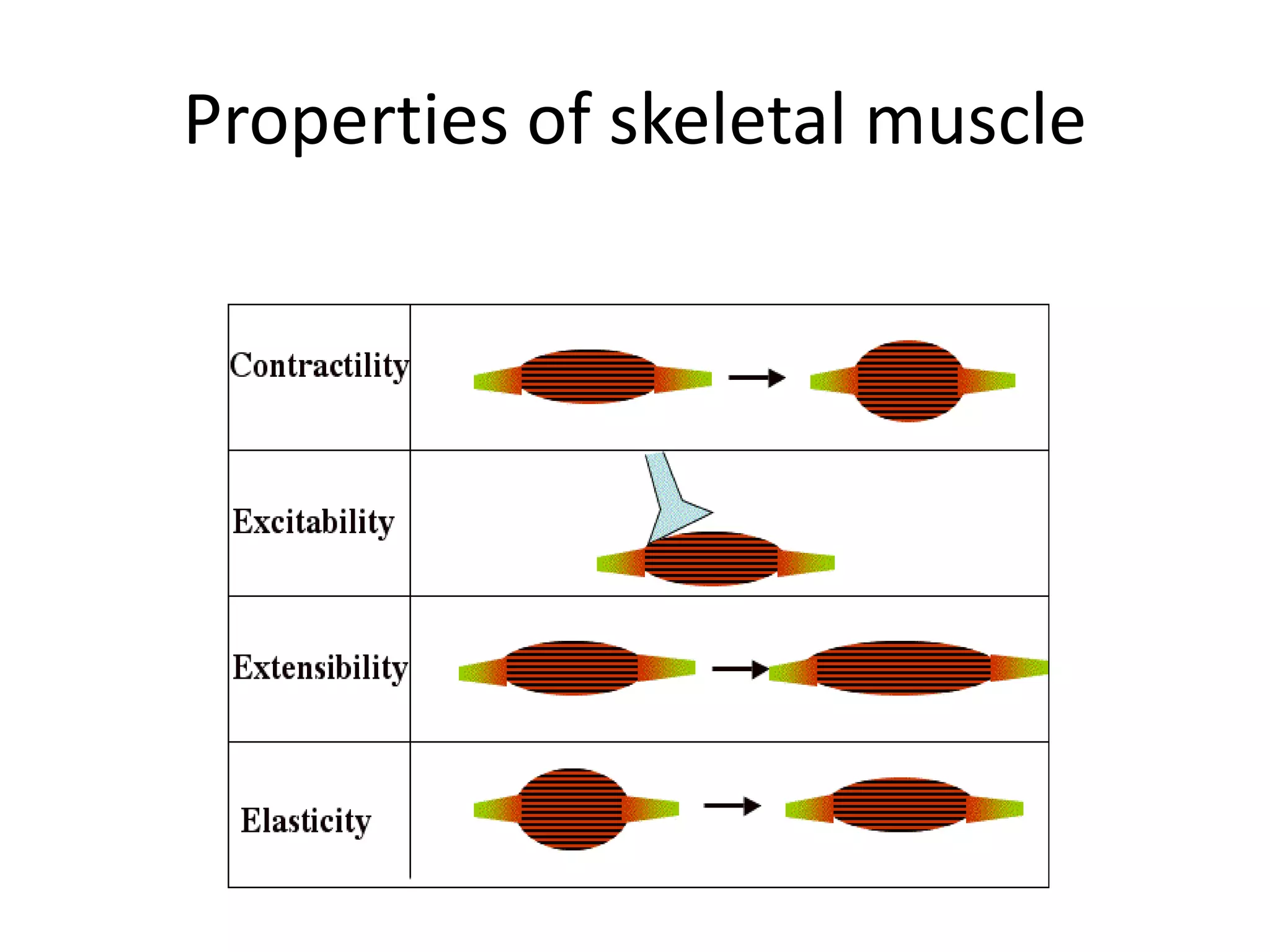
• Excitability (Irritability)
• Excitability is the ability of skeletal muscle fibres to respond to a stimulus by generating an action potential.
• This property allows the muscle to react to nerve impulses from motor neurons.
• Contractility
• Contractility is the ability of muscle fibres to shorten and develop tension when stimulated.
• It is the fundamental property responsible for movement of body parts.
• Extensibility
• Extensibility is the ability of muscle fibres to be stretched without damage.
• This property allows muscles to lengthen when acted upon by external forces.
• Elasticity
• Elasticity is the ability of muscle fibres to return to their original length after contraction or stretching.
• This property helps muscles maintain tone and restore resting length after activity.
• Functional importance
• These properties together allow skeletal muscles to generate force, maintain posture, and produce voluntary movements of the body.
Contraction of Skeletal Muscle


4
• Definition
• Contraction of skeletal muscle refers to the process by which muscle fibres develop tension and shorten in response to stimulation.
• Initiation of contraction
• Contraction begins with a nerve impulse reaching the neuromuscular junction, resulting in release of acetylcholine.
• Generation of muscle action potential
• Acetylcholine binds to receptors on the muscle membrane, producing depolarization and generation of a muscle action potential.
• Spread of electrical impulse
• The action potential spreads along the sarcolemma and through the transverse (T) tubules.
• Release of calcium ions
• The electrical signal triggers release of Ca²⁺ from the sarcoplasmic reticulum.
• Interaction of contractile proteins
• Calcium binds to troponin, causing movement of tropomyosin and exposure of actin binding sites.
• Myosin heads bind to actin forming cross bridges, resulting in sliding of filaments and shortening of the sarcomere.
• Energy requirement
• The process requires ATP, which provides energy for cross-bridge cycling and calcium transport.
• Outcome of contraction
• The repeated interaction of actin and myosin filaments leads to shortening of muscle fibres and generation of force, producing movement of the skeleton.
 Continue with Google