Topic Overview
General Introduction to the Upper Limb
MBBS study notes
The upper limb is specialized for prehension and skilled movement. Its mobility supports reaching, manipulation, and delicate tasks, while the same mobility reduces stability and contributes to its susceptibility to dislocation and injury.
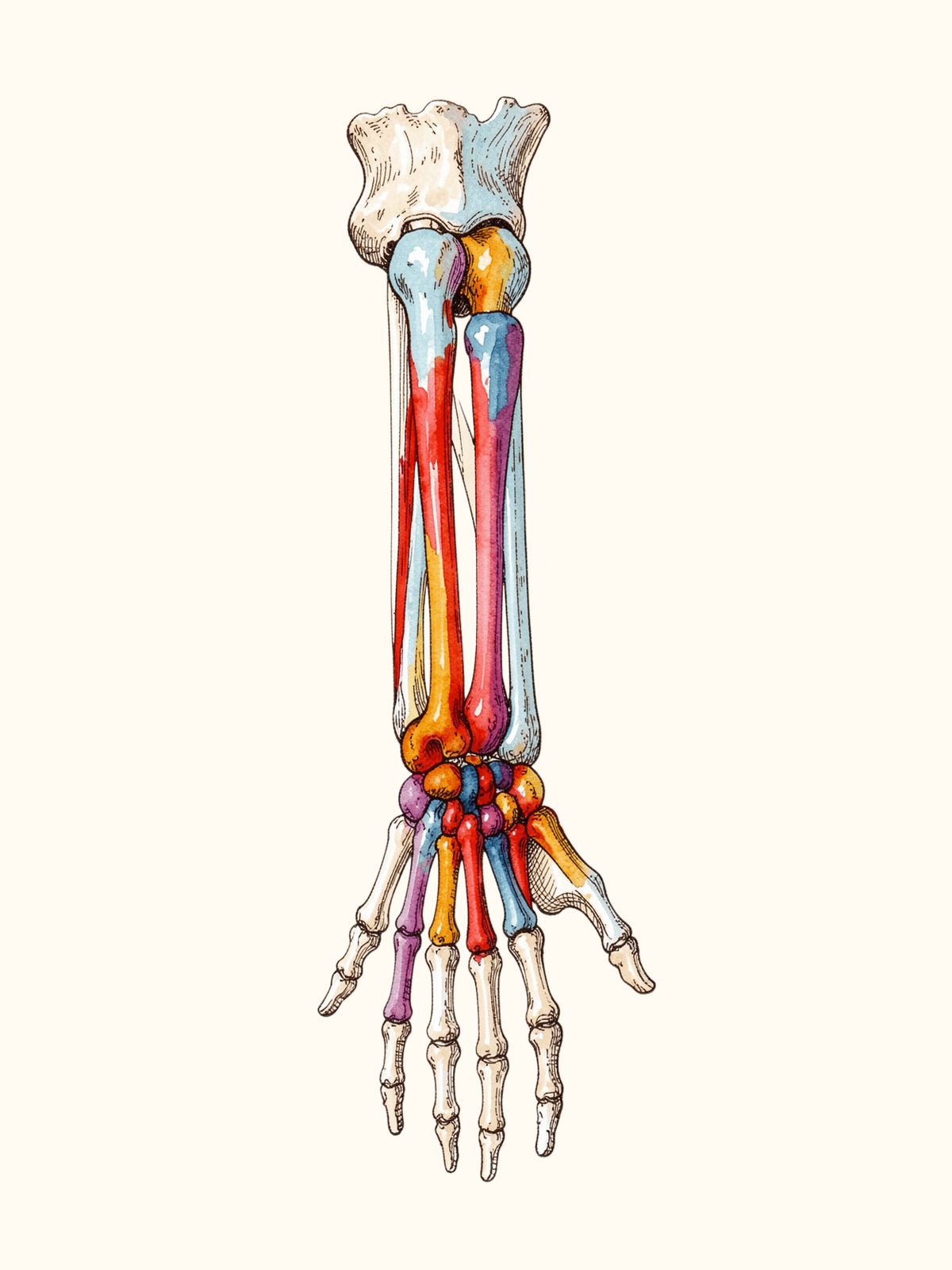
Upper-limb skeleton from the shoulder girdle to the hand. Schematic illustration; use an anatomical atlas for exact details.
General introduction
- Primary design. The upper limb is adapted mainly for prehension (grasping) and skilled movements.
- Mobility and stability. It has greater mobility than the lower limb, with a relative sacrifice in stability.
- Main functions. Reaching and manipulating objects; delicate tasks such as writing and suturing; fine motor control; and acting as an organ of expression and balance.
- Clinical relevance. The mobility of the upper limb makes it prone to dislocations and injuries.
Parts of the upper limb
The upper limb is described in four major parts: shoulder, arm, forearm, and hand.
|
Part
|
Extent and key structures
|
|
Shoulder
|
The region connecting the upper limb to the trunk. Includes the pectoral region and axilla, and provides attachment of the limb to the axial skeleton.
|
|
Arm (brachium)
|
Extends from shoulder to elbow. Contains the humerus, anterior and posterior muscle compartments, the brachial artery, and the musculocutaneous and radial nerves.
|
|
Forearm (antebrachium)
|
Extends from elbow to wrist. Contains the radius and ulna, flexor–pronator and extensor–supinator groups, radial and ulnar arteries, and median, ulnar, and radial nerves.
|
|
Hand (manus)
|
The distal part, specialized for fine movements. Contains carpals, metacarpals, and phalanges; the palm, dorsum, and digits have distinct structural and functional features.
|
Shoulder
- Pectoral region. Includes pectoral muscles such as pectoralis major and pectoralis minor.
- Axilla. A pyramidal space containing the neurovascular bundle.
- Role. Connects the limb to the trunk and provides attachment to the axial skeleton.
Arm or brachium
- Extent and bone. Shoulder to elbow; the humerus is the principal bone.
- Anterior flexor compartment. Biceps brachii, brachialis, and coracobrachialis; supplied mainly by the musculocutaneous nerve.
- Posterior extensor compartment. Triceps brachii; supplied mainly by the radial nerve.
- Main artery. Brachial artery.
Forearm or antebrachium
- Extent and bones. Elbow to wrist; contains the radius and ulna.
- Anterior compartment. Flexor–pronator group.
- Posterior compartment. Extensor–supinator group.
- Main vessels and nerves. Radial and ulnar arteries; median, ulnar, and radial nerves.
Hand or manus
- Skeleton. Carpals, metacarpals, and phalanges.
- Palm. Thick skin, palmar aponeurosis, and intrinsic muscles.
- Dorsum. Thinner skin and the dorsal venous arch.
- Digits and innervation. Digits are adapted for grasp and precision. Median, ulnar, and radial nerve innervation supports skilled activity.
Clinical anatomy
|
Clinical point
|
Relevance
|
|
Dislocations
|
The mobility of the upper limb predisposes to dislocation; the shoulder is the most common site.
|
|
Fractures
|
Common sites include the clavicle, scaphoid, and humerus.
|
|
Brachial plexus injuries
|
May affect multiple regions; examples include Erb’s palsy and Klumpke’s palsy.
|
|
Hand injuries
|
Can be especially disabling because they impair fine motor function.
|
Quick revision
The upper limb is built for mobility, prehension, and skilled activity. Its four parts are the shoulder, arm, forearm, and hand. Greater mobility supports precision but comes with reduced stability and greater vulnerability to injury.
Ready to study offline?
Get the full PDF version of this chapter.
 Continue with Google